


1.Common pain points of UV coatings
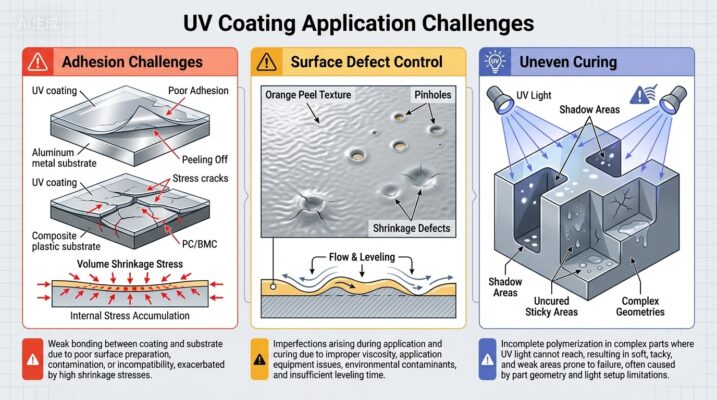
UV coatings have the advantages of fast curing speed, energy saving, VOC free, and space saving, and have become an important choice for industrial coating. But in UV coatings such as UV vacuum electroplating coatings and UV excimer skin sensitive coatings, there may be three major challenges:
● Difficulty in adhesion
UV coatings are difficult to form effective anchoring on dense substrates such as metals, and the volume shrinkage caused by rapid curing can generate internal stress, leading to a decrease in adhesion. For materials such as glass and PP, adhesion issues are also very tricky.
● Difficulty in controlling surface defects
The high-speed curing characteristics make the coating leveling time very short, and defects such as orange peel, shrinkage, and pinholes are prone to occur. These defects are closely related to the surface tension, leveling, solvent evaporation, and bubble release during the curing process of the coating.
● Uneven solidification of complex workpieces
For irregular parts or three-dimensional workpieces, UV light irradiation can easily create shadow areas, resulting in uneven curing, white spots, cracks, or non drying and sticking in areas such as grooves and corners
In the above issues, we can solve the problems of adhesion and surface defects by adding suitable adhesion promoters and surface additives. However, before that, we need to understand the reaction mechanism of UV curing and how additives solve pain points from the root? And help you screen suitable products.
2. Three key reaction processes at the UV molecular level
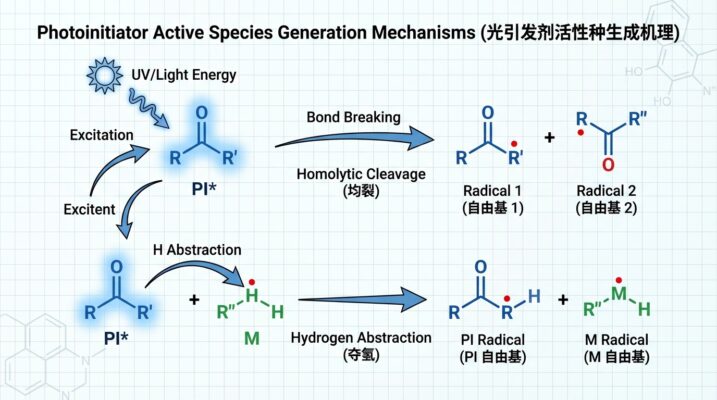
● Active species generated by light energy
The UV light source emits ultraviolet light within a specific wavelength range. The photoinitiator absorbs UV photons and transitions from the ground state to the excited state. The photoinitiator (PI) generates active species – free radicals. This process can generally be divided into cleavage type (Type I) and hydrogen abstraction type (Type II)
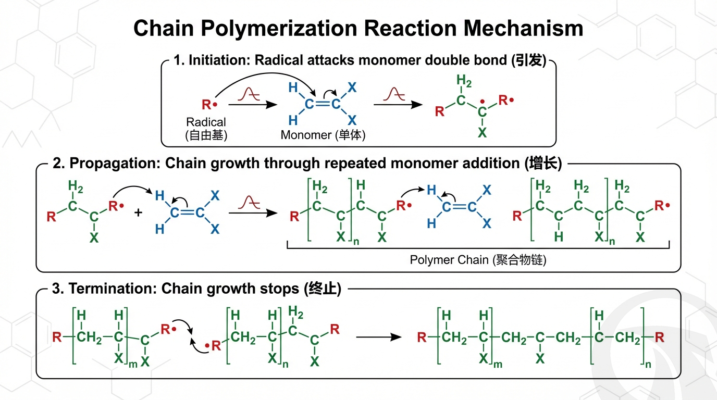
● Generate chain polymerization reaction
The generated free radicals will attack the unsaturated double bonds or epoxy groups on the monomer/oligomer molecules in the formula, causing them to open chemical bonds and begin chain growth, resulting in a chain polymerization reaction. The adhesion promoting agent begins to participate in the reaction;
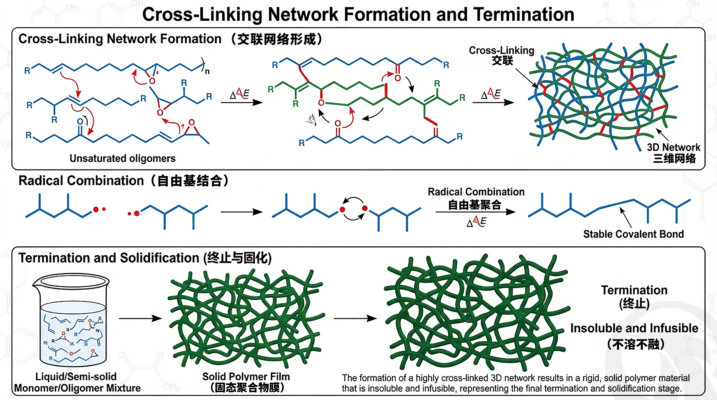
● Formation and termination of cross-linked networks
Due to the presence of multiple reactive functional groups in unsaturated oligomers, a triple crosslinked network is formed. When free radicals bind to each other, the active chains are exhausted, and the chain growth reaction is terminated, a strong, insoluble solid polymer film is transformed.
4. Dual chemical anchoring promotes adhesion
The core function of adhesion promoter is to solve the problem of insufficient adhesion of coatings to substrates (such as plastic, metal, glass), acting between resin and substrate. Through coating and other processes, the pro substrate end of the adhesion promoter will quickly anchor to the substrate surface, and during the radiation curing process, it will react with the resin to form a film, improving the adhesion strength of the UV coating.
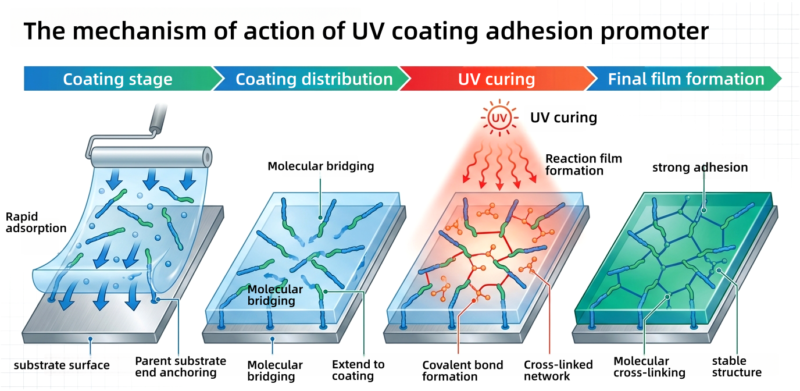
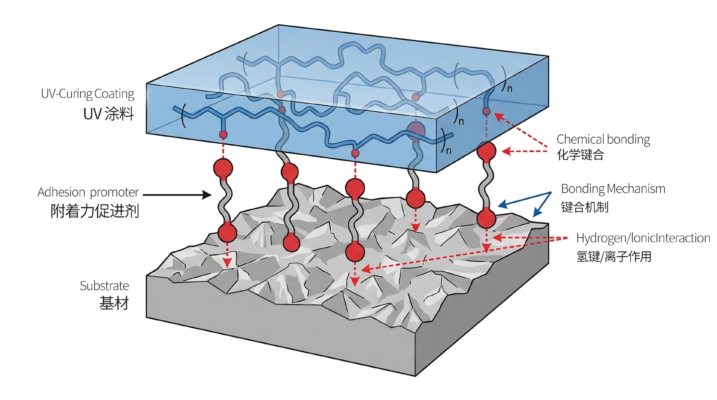
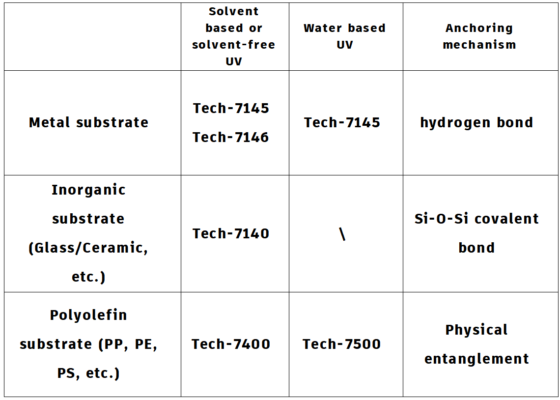
Due to its effect on the substrate, the adhesion promoter used varies depending on the surface properties of different substrates. For example, Tech-7145 containing acidic phosphate esters can form hydrogen bonds and anchor with metal substrates; Tech-7140 containing organic silicon can form stable Si-O-Si covalent bonds with inorganic substrates (such as glass and ceramics) and anchor them on the surface of inorganic materials, and is not easily yellowed; For inert substrates that cannot react (such as PP/PE/PS), physical winding is a better
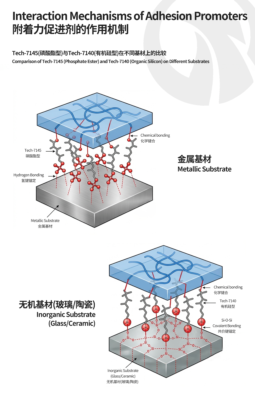
Anchoring mechanism of different substrates:
Adhesive promoters with the same mechanism and functional groups can also have different timing of action in the system, which is closely related to the number of active functional groups in the additive and whether the performance of the additive can be effectively exerted, adapting to different process flows.
Solution | Solvent-free epoxy color sand additive kit
Solution | Epoxy floor coating additives
What to do if quick-drying diluents cause dullness and orange peel effect?
Configuration and Performance Mechanism of Water based Organosilicon Additives
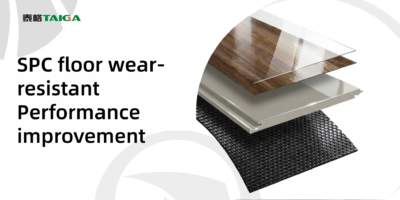
Product recommendation | Improvement of wear resistance of SPC flooring