

1 – The Challenge of UV Wood Coatings
The performance of UV wood coatings in practical applications is influenced by some common technical factors, such as the integrity of the paint film appearance, the achievement of low gloss effects, the balance between surface properties and interlayer adhesion, and the adaptability to different construction processes. These aspects can usually be optimized through targeted additive application schemes.
The defoaming ability and compatibility of the formula are important factors affecting its construction adaptability and paint film quality. If there are small bubbles or pinholes in the paint film, it may not only affect the visual effect, but also to some extent affect the overall performance of the paint film.
In solvent-free UV curing systems, the shrinkage rate of the paint film is relatively low, which may increase the difficulty of obtaining lower surface gloss and require the use of matting materials. On the other hand, it affects the viscosity of the system, so the dispersion and stability effects of matting materials need to be focused on.
Some additives used to improve surface smoothness, hand feel, and scratch resistance need to be comprehensively considered for their compatibility with the system and potential impact on subsequent coating adhesion when applied.
With the continuous improvement of environmental protection requirements, the upgrading of coating formulations continues, such as using products that do not contain aromatic solvents or organotin catalysts to meet environmental needs.
2 – Various process system supporting additives
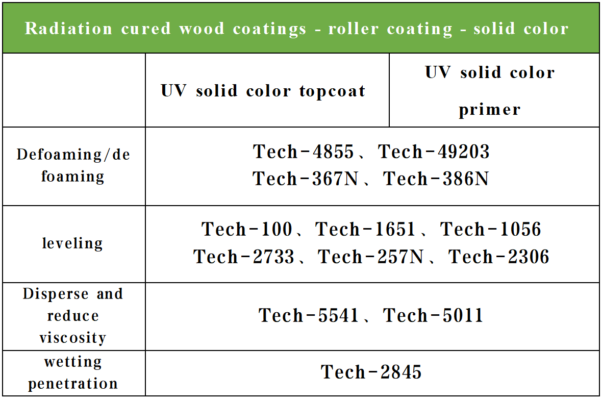
● Supporting scheme for roller coating process additives
The roller coating process is suitable for rapid construction, especially for continuous production of panel furniture, as well as the common “wet touch wet” process system. Common pain points include:
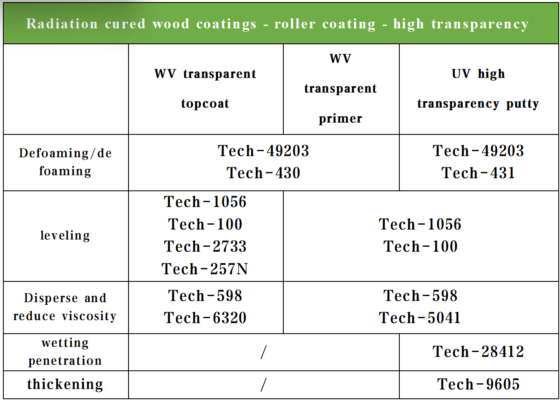
① Bubble problem: Air is easily sucked into the coating during high-speed rotation of the roller. In high flow roller coating, the main test is the ability of the coating to suppress bubbles and eliminate microbubbles.
② Compatibility issue: In high transparency systems, using the principle of incompatibility defoamers, while meeting defoaming performance, cannot affect the transparency of high transparency coatings, mainly testing the control of critical compatibility in defoaming applications.
③ Short leveling window: The high-speed coating process combined with thin film thickness requires the coating to have excellent instantaneous leveling and substrate wetting properties to eliminate roll marks and mechanically introduced bubbles, resulting in a smooth surface.
● Spray coating process additive matching scheme
The spraying process is suitable for non flat workpieces, and common pain points include:
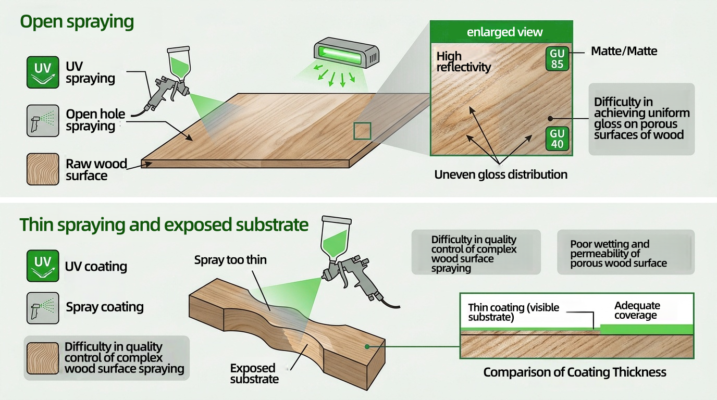
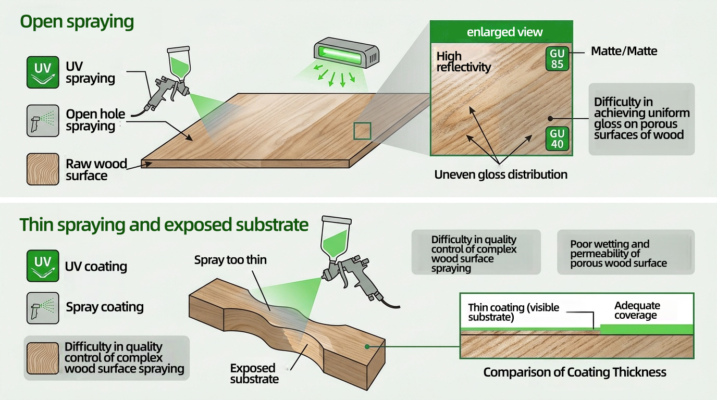
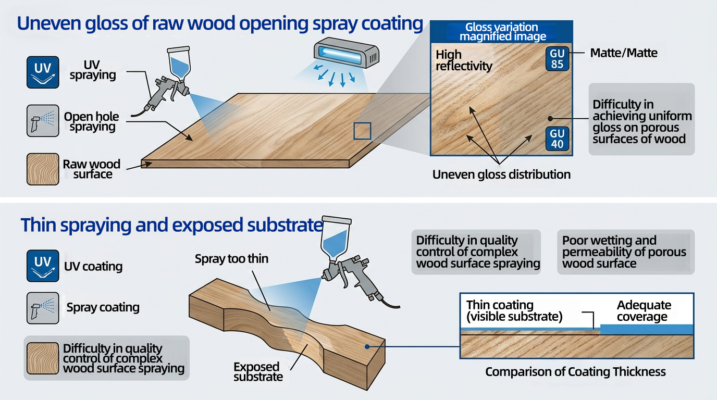
① Uneven film thickness and poor fullness: In open spraying, the surface of wood is loose and porous, with uneven texture, which may cause selective absorption of paint (more paint absorption in porous areas and less paint absorption in dense areas), affecting the uniformity of high gloss.
② Thin spray leakage: When spraying thin coatings on heterogeneous parts, the spraying quality is difficult to control, which tests the performance of porous wetting and penetration of the coating. It is necessary to achieve uniform coverage and protective effect to improve the yield rate.
● Supporting scheme for coating process additives
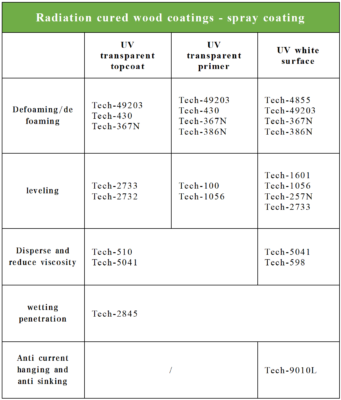
The spray coating process is suitable for efficient coating of flat components such as door panels, floors, and countertops. Common pain points include:
① Curtain breakage and instability: Factors such as paint flow rate, viscosity, temperature fluctuations, etc. may disrupt the continuity of the curtain. Improper rheological agents in the formula may also cause the curtain to have “brushed” or “serrated edges”.
② Bubbles and pinholes: When spraying, the paint falls from a high position, and the curtain is easily wrapped in air. If the paint has poor defoaming properties, bubbles will flow onto the workpiece with the curtain, and the air in the wood pores will be quickly covered and difficult to escape.
③ Uneven film thickness and “orange peel”: Unstable curtains, fluctuating workpiece transport speeds, or uneven substrates can all lead to uneven film thickness. If it cannot be fully leveled before curing, orange peel patterns will form, affecting the flatness.
● UV Wood Color Paste Additive Supporting Scheme
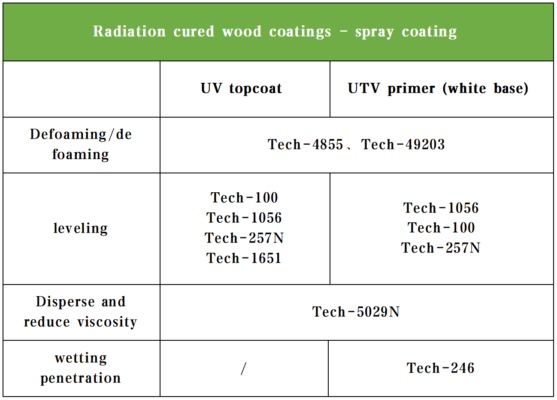
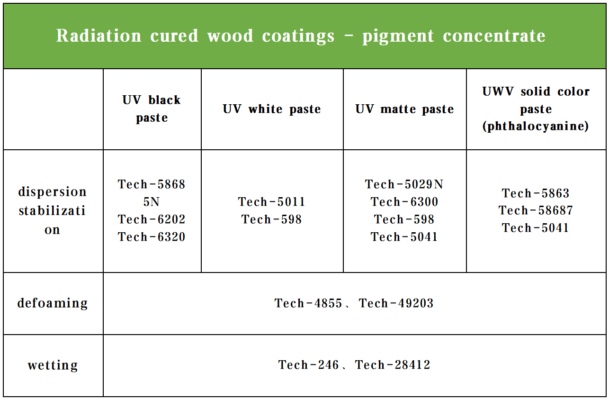
UV wood color paste needs to combine high pigment content with the fast reaction and low solvent characteristics of the UV curing system. Common pain points include:
① Difficulty in dispersion and sudden increase in viscosity: In order to achieve high coloring power, the pigment content of the color paste is high (usually 30% -50%), and the flowability of the color paste is poor, making it difficult to pump and measure, which also affects the miscibility with the main paint.
② Sedimentation and flocculation: The UV system continuously evaporates without solvent to maintain density balance, and pigments with high density tend to settle in resins with relatively low viscosity. When the dispersion stability is insufficient, the color paste will solidify and become coarse, and it needs to be stirred and restored before use, which may lead to color differences between batches.
③ Floating color hair: Different pigments have different wettability and mobility in UV resin. In the wet touch wet coating process, partially cured pigments in the lower layer may migrate to the upper layer, and color differences may occur in different parts of the workpiece.
④ Compatibility and recoating: The dispersing resin, monomer, and main coating system used in the color paste are not completely compatible, and the dispersant or monomer may migrate to the surface of the paint film, affecting interlayer adhesion.
3 – Basic Recommended Formula
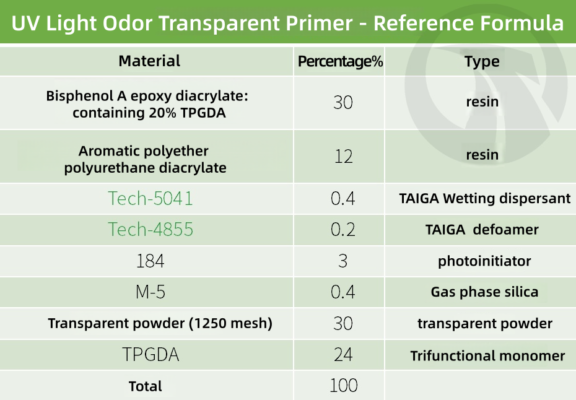
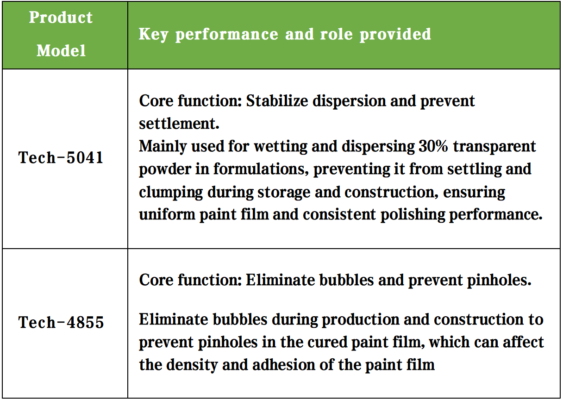
● UV lightweight transparent primer focuses on efficient filling, strong adhesion, easy polishing, and construction stability. Wetting dispersant is used to wet and disperse 30% of transparent powder, preventing it from settling and clumping during storage and construction, ensuring uniform paint film and consistent polishing performance.
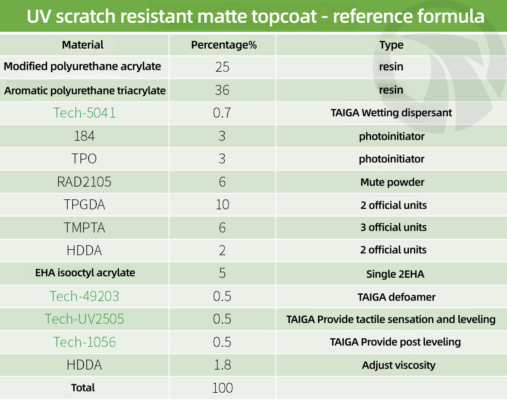
● UV scratch resistant matte topcoat focuses on high hardness, high toughness, and excellent hand feel, while balancing flexibility and shrinkage, and ensuring deep curing. Multiple surface additives provide hand feel, leveling, and post leveling, ensuring a smooth and even matte surface and comfortable hand feel.
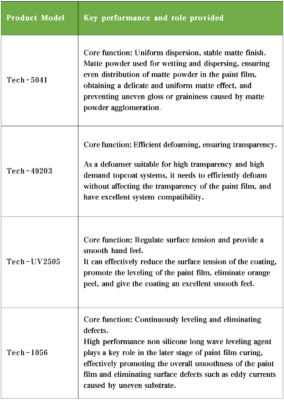
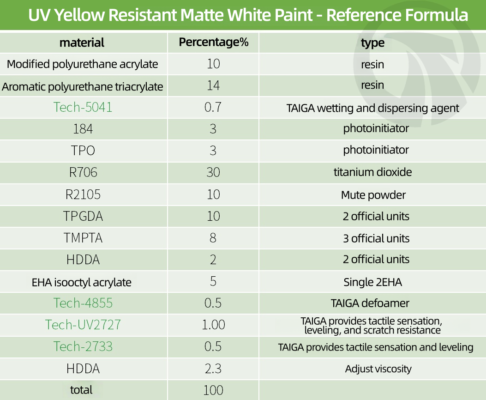
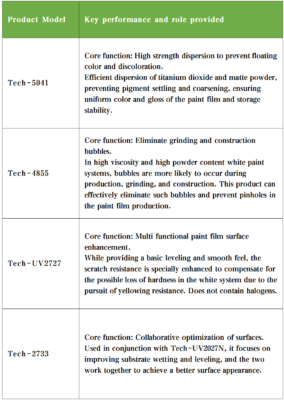
● UV anti yellowing matte white surface paint focuses on high coverage, matte finish, and long-lasting resistance to yellowing, while also balancing hand feel and scratch resistance. At high powder content (titanium dioxide+matte powder), wetting and dispersing agents are used to ensure stable pigment dispersion, prevent sedimentation and coarsening.
The supporting solution for UV wood coating additives is a systematic project that requires scientific selection and optimization of combinations based on specific application requirements, construction processes, environmental requirements, and other factors.
Solution | Solvent-free epoxy color sand additive kit
Solution | Epoxy floor coating additives
What to do if quick-drying diluents cause dullness and orange peel effect?
Configuration and Performance Mechanism of Water based Organosilicon Additives
Product recommendation | Improvement of wear resistance of SPC flooring