


UV matte skin coating is widely used in high-end consumer electronics, automotive interiors, high-end furniture and other fields due to its high-end texture, excellent scratch resistance and soft luster. However, there is an inherent technical contradiction between matte finish and smoothness (low friction coefficient), which has become a core challenge in formula design. By comparing and testing Tiggo additives, we aim to deeply analyze the sources and mechanisms of skin sensation and smoothness.
01. The core contradiction of UV matte skin coating
UV curing technology has become the mainstream choice for modern industrial coatings due to its advantages of low temperature, speed, and environmental friendliness, while UV skin sensitive coatings are favored by the market for their silky smooth and matte texture.
The implementation of matte and skin like effects is essentially achieved by introducing micro roughness to disrupt specular reflection. There are usually two methods used:

Regardless of the method, their common feature is deliberately increasing the surface roughness of the coating. And this goes against the goal of pursuing smoothness.
Core contradiction: The game between smoothness and matte finish
High smoothness means that objects have less resistance when moving smoothly on the coating surface, and friction is directly related to the roughness of the contact surface. The smoother and smoother the coating surface, the larger the actual contact area. If the surface energy of the coating can be reduced, excellent smoothness can be achieved.
However, in matte skin coating, a large number of matte powder particles or protrusions generated by uneven curing form countless microscopic “peaks” and “valleys”. When fingers come into contact with UV skin coating:
The actual contact area is small: contact only occurs on these “peaks”, and local pressure increases.
Strong mechanical meshing effect: When the skin slides on the coating surface, the micro protrusions on the friction surface collide and scrape with each other, generating significant mechanical resistance.
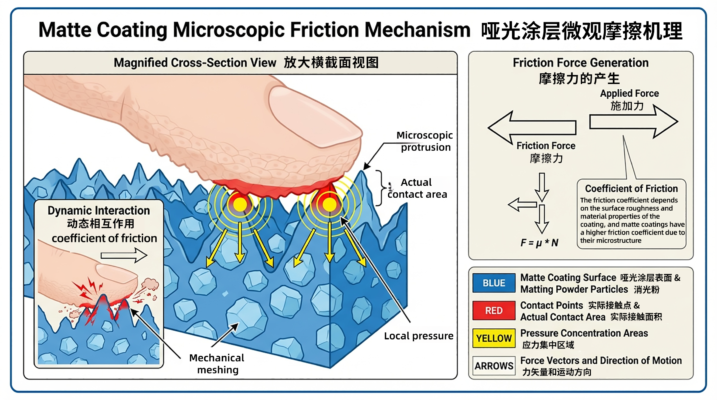
Generally speaking, unoptimized matte coatings naturally have high friction coefficients and a sense of roughness. The addition of matting agents/matte powders often seriously interferes with the curing efficiency and exacerbates the instability of the surface state, making the screening of slip additives particularly difficult. To solve the core contradiction, it is necessary to:
Without changing the slow reflection of light,Change the micro surface properties of the coating
These two aspects of coating are the key to resolving the core contradiction: Low coating surface energy and formation of micro lubricating layer.
2. The relationship between low surface energy and droplet angle
Surface energy is the manifestation of the unbalanced force field experienced by the surface molecules of a material. A low surface energy of a coating contributes to the improvement of skin feel and anti graffiti performance, while contact angle is an intuitive indicator for measuring the surface energy of a coating.
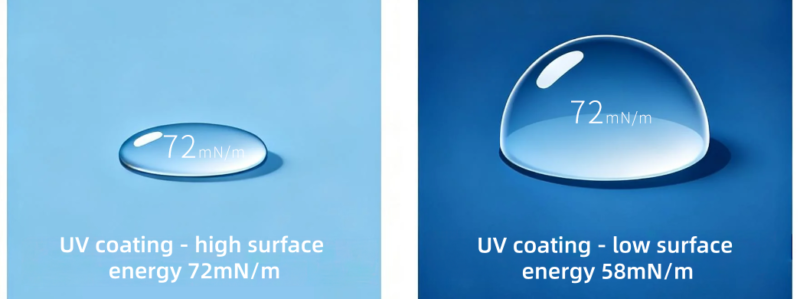
The morphology of water droplets on the surface of UV coating (with different surface energies)
Generally speaking, the larger the angle of water droplets on the surface of the coating, the lower the surface energy of the coating. If a specific coating of Tech-UV2505 is added, the surface energy of the coating can be significantly reduced, and the droplet shape is full, with a droplet angle of 103 °.
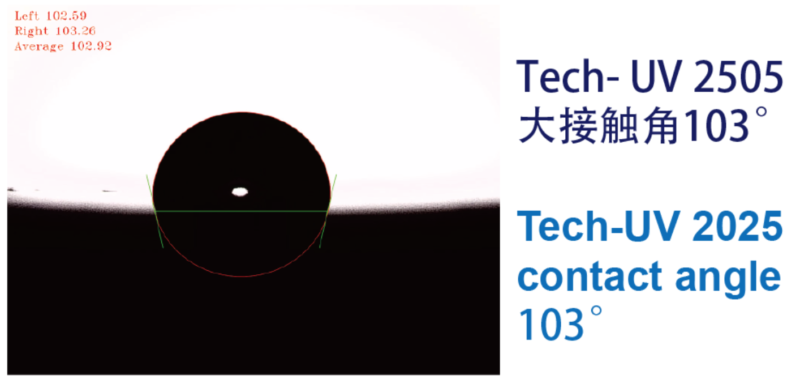
Tech-UV2505 Low Surface Energy Coating -103 ° Water Drop Contact Angle

Control group 1 and 2 high surface energy coatings – contact angle of water droplets at -73 °/67 °
● Non polarity of organosilicon → low surface energy
The non-polar group methyl-CH3 forms a low surface energy. The C-H bonds of methyl – CH3 are symmetrically arranged on the chain segment of organosilicon additives, and the bond dipoles cancel each other out, resulting in a net dipole moment of zero for the entire methyl group. There is almost no polar interaction or hydrogen bonding with other molecules, presenting a non-polar (Non Polar) state. In addition, the electronegativity of silicon (1.90) is lower than that of carbon (2.55), which means that in Si-C bonds, the electron cloud will slightly lean towards the carbon side, increasing the “non-polar” property
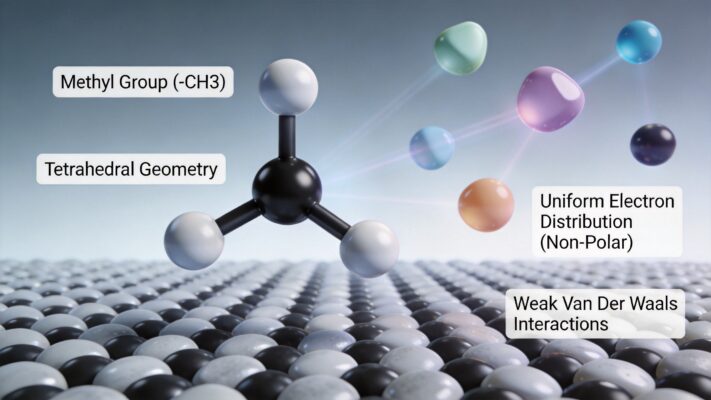
● Enhance the droplet angle of UV skin coating
In the UV skin coating test, the droplet angle of the coating with Tech-UV2505 added (93.70 °) increased by 5.83 ° compared to the blank control group (87.87 °), indicating that Tech-UV2505 significantly reduced the surface energy of the UV skin coating while maintaining good compatibility.
Tech-2127, with lower molecular weight and higher active content, has a faster migration speed and better molecular arrangement, resulting in a droplet angle of 94.32 ° for ultra-thin UV skin coating.

It is worth noting that incomplete migration of additives may be trapped during the UV curing process. When the process allows, appropriately extending the leveling time and optimizing the preheating temperature can provide sufficient window for the migration of additives, which helps to stabilize the skin feel of the coating.
3. Soft Chain Segment and Friction Coefficient
The coefficient of friction (COF) is a direct quantitative indicator of smoothness. The Kinetic Friction Coefficient can reflect the smoothness during continuous sliding.
Adding silicone lubricant additives to UV coatings, due to their mobility, will gradually migrate from the interior of the coating to the surface of the coating (air coating interface) and arrange in a directional manner before curing. The low surface energy functional groups (such as – CH3 methyl) of the silicone additives face outward, creating a low surface energy of the coating and forming a soft and ordered micro lubricating layer.
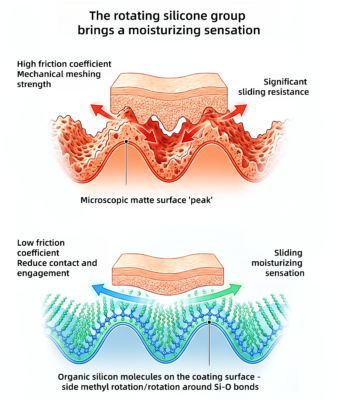
The formation of micro lubrication layer benefits from:
① Smooth main chain (Si-O-Si). Si-O-Si has a low internal rotation potential barrier, with longer Si-O bonds (about 1.64 Å) and larger Si-O-Si bond angles (usually between 140 ° -180 °, much larger than the bond angle of C-C-C). Even after modified grafting, it can still maintain excellent dynamic flexibility at the microscopic level;
② Easy to rotate side chain (- CH3). -The activation energy required for CH3 methyl to rotate around the Si-O-Si main chain is very low.
We used the BGD-633 friction coefficient tester to compare the friction coefficient (COF) values of different silicone additives in the UV matte skin feel system under the GB-T10006-2021 testing standard.
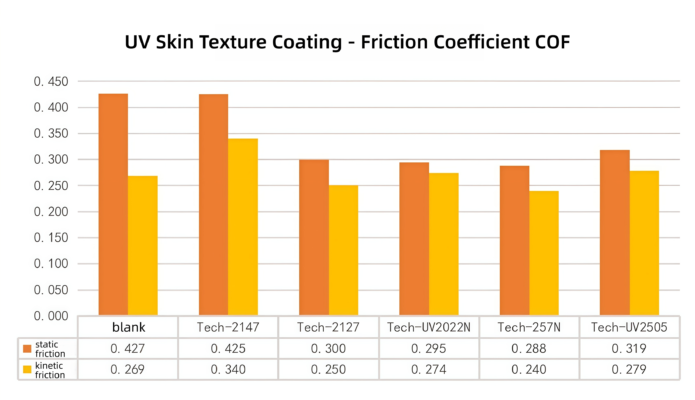
From the data, it can be seen that Tech-2127 and Tech-257N significantly increase the droplet angle (reduce surface energy) while reducing the dynamic friction coefficient to a lower level. The soft and ordered molecular layer can effectively reduce the direct contact and mechanical engagement between surface micro “peaks” and the skin.
4. Summary
By using high-performance organic silicon additives, the micro surface properties of the coating are changed, endowing the UV skin coating surface with low coating surface energy and micro lubrication layer, achieving high droplet angle and low friction coefficient on the UV skin coating surface;
The use of organic silicon additives containing reactive groups (such as Tech-UV2505) can endow UV skin coatings with long-lasting smoothness, stain resistance, and excellent scrub resistance, achieving a ‘long-lasting skin feel’.
Solution | Solvent-free epoxy color sand additive kit
Solution | Epoxy floor coating additives
What to do if quick-drying diluents cause dullness and orange peel effect?
Configuration and Performance Mechanism of Water based Organosilicon Additives
Product recommendation | Improvement of wear resistance of SPC flooring