Release Date:2026-05-27 09:45:00
News Category: Company News
Introduction: The diversification of dispersants has led to the development of various types with specific performance characteristics—some prioritizing stability, others color, and still others viscosity reduction, among others. In today’s era of environmental sustainability, as solvent-based coatings strive for higher PVC content and lower VOC emissions, the flow properties and uniformity of the slurry have become the primary issues that need to be addressed.
1Challenges with Environmentally Friendly High-Solids Slurries
High-solids slurries have a volume solids content exceeding 60% (for reference: the typical range for PVC in general topcoats is 0.25–0.45), and the film thickness achieved in a single coat is 1 to 4 times greater than that of traditional coatings, effectively reducing the number of coats required and lowering VOC emissions, among many other advantages.

One of the challenges encountered during the production of environmentally friendly high-solid-content slurries is the reduction in flowability and uniformity caused by exceeding the critical pigment volume concentration (CPVC). This is particularly common in carbon nanotube (CNT) slurries, because at this point, the voids between solid particles are completely filled by the binder (such as polyacrylic resin), altering the rheological properties and resulting in significant changes in performance.
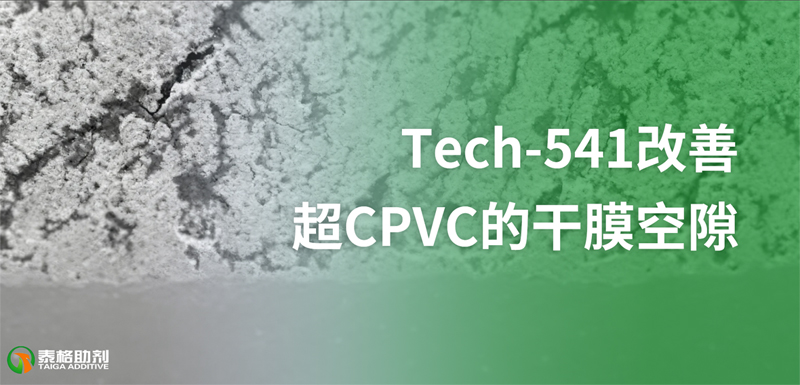
Adding too much powder—exceeding the CPVC content—will result in poor rheological properties (reduced flowability) of the slurry, leading to voids between particles and residual air bubbles. This affects the cross-linking density of the resin (binder), thereby reducing the coating’s corrosion resistance (making it more susceptible to water vapor and ion penetration) and mechanical strength (such as adhesion and hardness). If necessary, the volume percentage of non-volatile matter (NVVp) in the base slurry can be determined in accordance with the international standard ISO 3233-1:2019.
2Improving and Controlling PVC
The mechanism of action of Tech-541 dispersant from Tiger Additives is to achieve higher NVVp and lower VOCs in high-solids pastes by altering the dispersion state of pigment and filler particles, reducing interparticle gaps, improving particle alignment, and optimizing the interaction between the binder and pigments.
Extensive application testing has shown that Tech-541 enables high pigment loading in slurries, effectively reduces dispersion time, and exhibits broad compatibility, making it particularly suitable for dispersing inorganic particles such as titanium dioxide and bentonite.
2.1Actual Performance Tests
We selected similar international products (competitors) for comparison and dispersed titanium dioxide and yellow/red iron oxide in a thermoplastic acrylic system to conduct a side-by-side comparison of the performance differences among the dispersants.
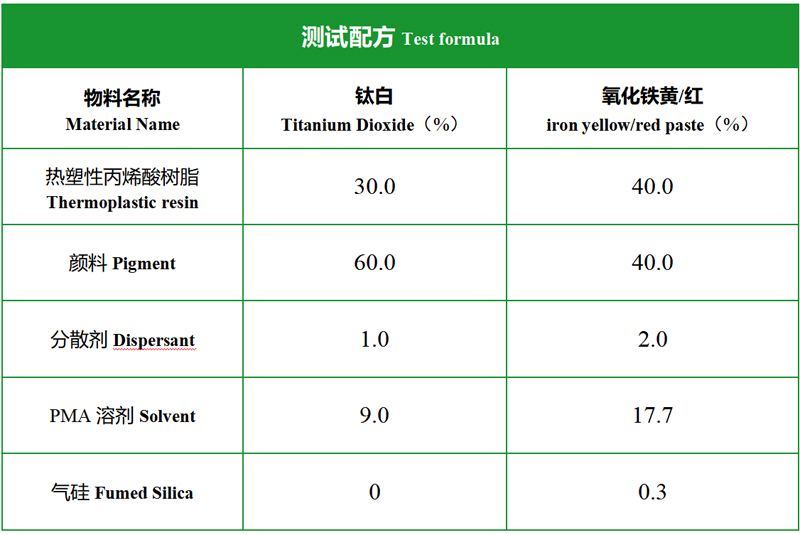
Liquidity: A Key Advantage
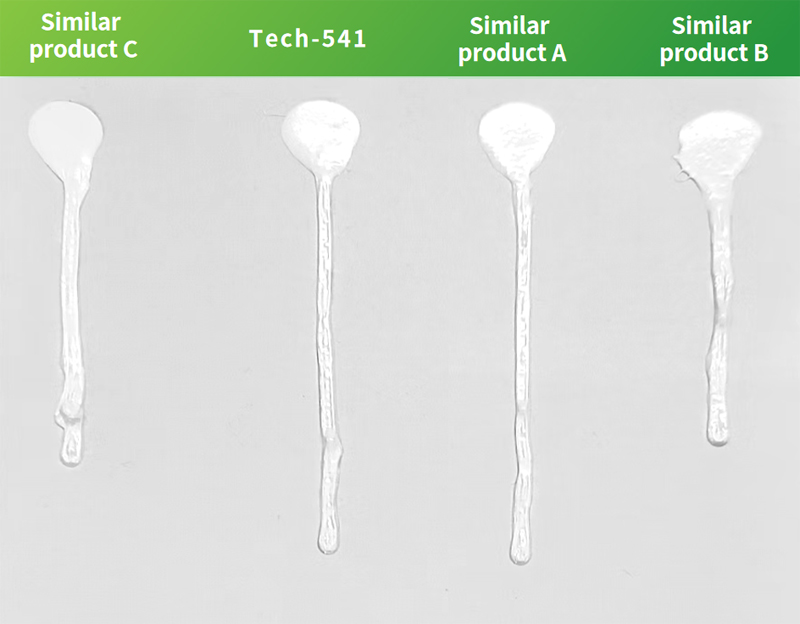
Flowability: Tech-541—Thermoplastic Acrylic System—Titanium Dioxide
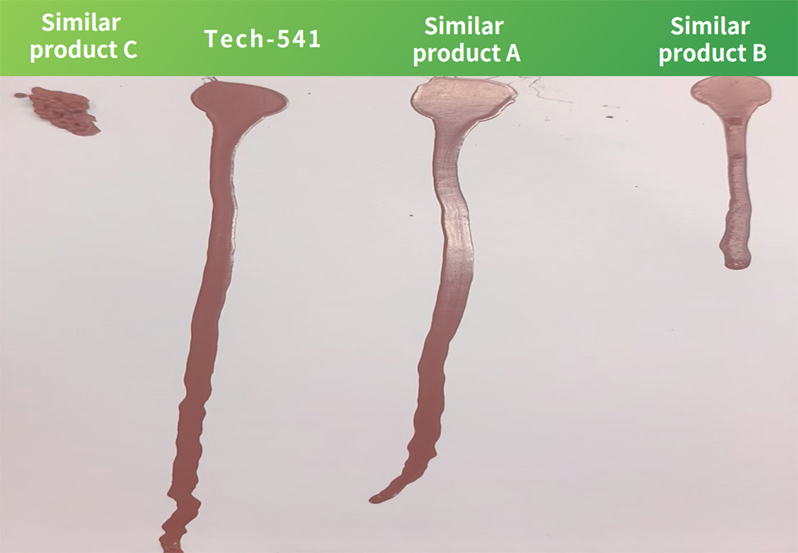
Flowability: Tech-541—Thermoplastic Acrylic System—Iron Oxide Red
 Return to list